MeldMedium
This case study is ongoing. Results below are updated as new data comes in. Last updated July 16, Day 8.
Case Study: Answer Engine Marketing

From invisible in AI Mode to standing next to the market leaders. In under a week.

A senior home care provider's site scored 23/100 on AI visibility and didn't appear when Google's AI answered questions in their own category. After a 53-page technical build, they're appearing in AI Mode next to Comfort Keepers and Visiting Angels, verified with the same independent scoring tool, checked again 7 days after launch.

0 100 was 23
23
AI Search Score
Independently scored, checked again 7 days after launch
0
50
Answer Pages Indexed
<1
WEEK
To Full Indexing
vs. weeks-to-months typical
Appearing in AI Mode
was not appearing
Ongoing monitoring: updates as data matures
$208.92
$39.22
Cost Per Conversion
#2
Best Page, Organic Ranking
10.5×
Conversion Rate vs. 6-mo Baseline
What this actually is

This isn't a replacement for running ads. It's an accelerant. AI Max is what gets a new page indexed and in front of real queries fast, instead of waiting weeks or months for Google to notice it organically. Once a page has actually been served enough to prove itself as a genuinely good answer, Google keeps citing it whether the campaign is still running or not, same as any organically-earned ranking. The pages still exposed if spend stops are the ones that haven't been served enough yet to prove themselves. This isn't "run ads forever or lose everything." It's "keep the campaign running to keep bootstrapping new pages," with each page's dependency fading once it's proven out.

"The best ads are answers."

— Vidhya Srinivasan, VP/GM of Ads, Google, at Google Marketing Live 2026

Not a full replacement for SEO, but a replacement for the part that actually hurts: the months-long wait and the backlink chase most new content never survives.

The real test: before and after

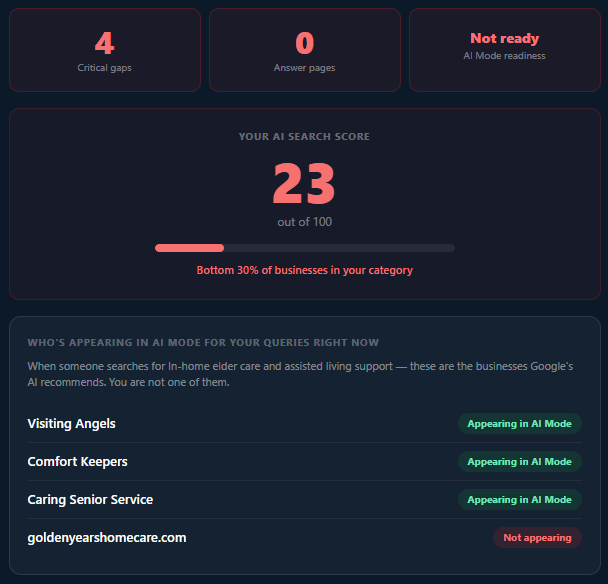
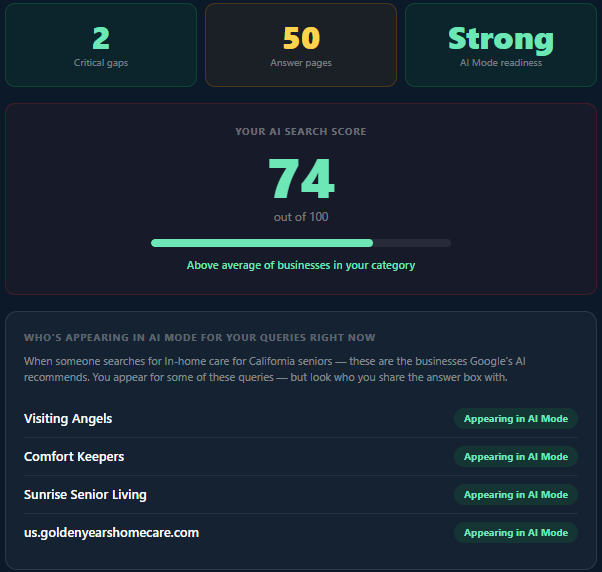
Not a claim. The same AI Search Check tool, run against the same business. Left is where Golden Years stood before this build. Right is where they stand now, checked again 7 days after launch.

Before
goldenyearshomecare.com: bottom 30% of businesses in category, not appearing in AI Mode
After
us.goldenyearshomecare.com: above category average, appearing in AI Mode

Not a score. An actual answer.

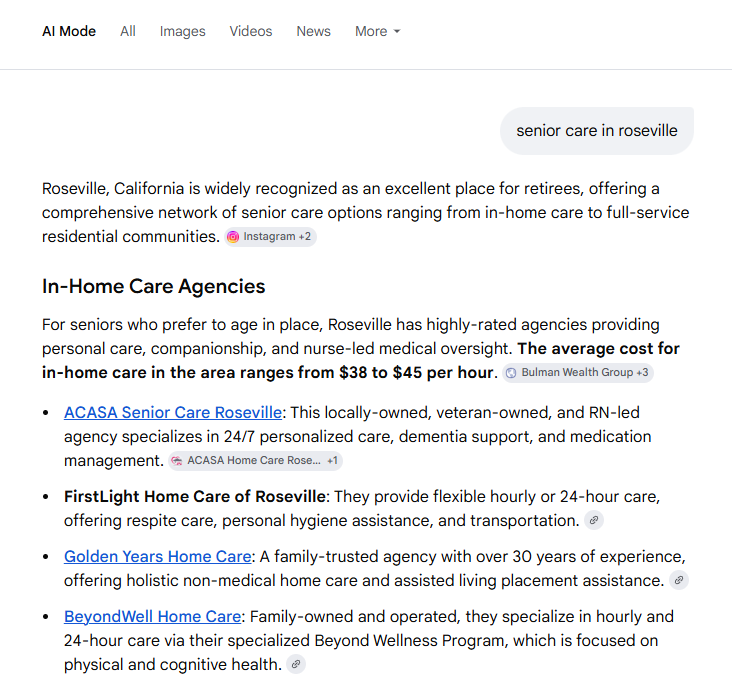
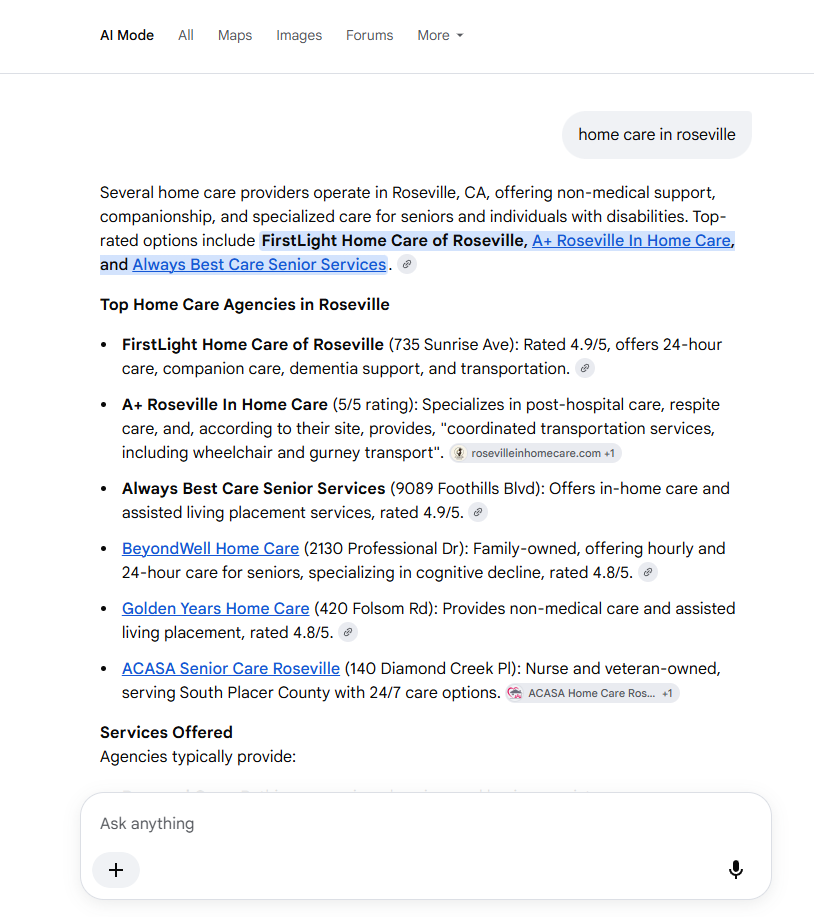
The AI Search Score above is a scoring tool's read on visibility. This is what Google's AI Mode actually returned, live, for two real searches — Golden Years named by the business, standing next to the same competitors the score predicted.

Query: "senior care in Roseville"
Golden Years Home Care listed alongside ACASA Senior Care, FirstLight Home Care, and BeyondWell Home Care
Query: "home care in Roseville"
Golden Years Home Care, rated 4.8/5, listed by name and address alongside five other agencies

The problem most local sites have

Most home-service and local business sites take weeks to get new pages indexed, if they get indexed at all. Slow JavaScript rendering, missing sitemaps, thin internal linking, and broken schema markup keep Google (and now AI Overviews) from ever finding the content that was built to rank. Worse: if you're running paid search with AI Max's Final URL Expansion, un-indexed pages simply aren't eligible to receive traffic, so the ad spend runs anyway, just with a shrunken pool of pages to work with.

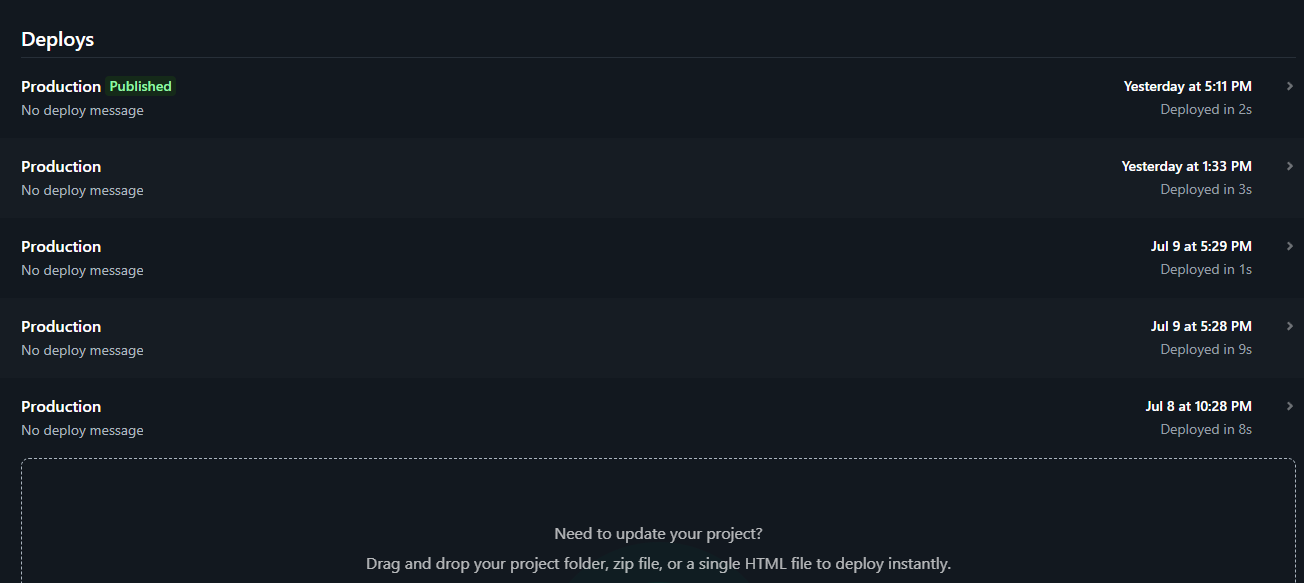
Day 0: July 8
53-page static site deployed, HTTPS live
Every page hand-built from a 50-question content blueprint (cost, eligibility, dementia care, hospital discharge, four city-specific service pages), with schema, GA4/Ads tracking, and Consent Mode v2 baked in from the first commit.
Netlify deploy log: first production deploy, July 8
Day 3: July 11
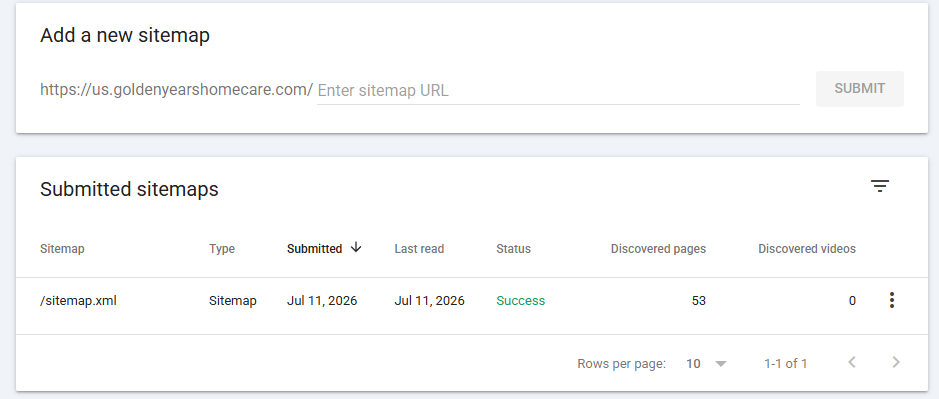
Sitemap confirmed: 53 of 53 pages discovered
Search Console verified via the domain's live GA4 tag: no DNS changes, no waiting. Sitemap submission came back "Success" the same day, and priority pages were already indexed independently before manual requests were even needed.
Search Console: sitemap status
Ongoing
AI Max live across the full site
Final URL Expansion is turned on domain-wide. Google's AI selects the best-matching answer page per query in real time, which only works because every page is indexed and clean.

What actually made it fast

None of this was a trick. It's what happens when the technical fundamentals are done correctly the first time.

Static HTML, zero render delay

No JavaScript for crawlers to wait on. Every page loads complete on first request.

Sitemap referenced in robots.txt

Googlebot finds the full page list the moment it touches the domain, no manual step required.

Dense internal linking

Every answer page links to related questions and city pages, giving crawlers multiple paths to every URL.

Schema validated before launch

LocalBusiness, Organization, and FAQ markup checked against Google's Rich Results Test, not assumed correct.

Independently verified — and it used to be this slow

Google's own PageSpeed Insights tool, run against the live site. Before this build, the old site loaded slowly enough on mobile that it was actively working against both AI crawlability and conversions. Includes "Agentic Browsing," a newer category checking whether a site is actually readable by AI agents, which is the entire point of this build.

Performance score

Mobile: 32 → 95. Desktop: 36 → 99. Not a tweak, close to a 3x jump on both, verified with the same tool against the old site and the new one.

Before: Desktop, 36/100
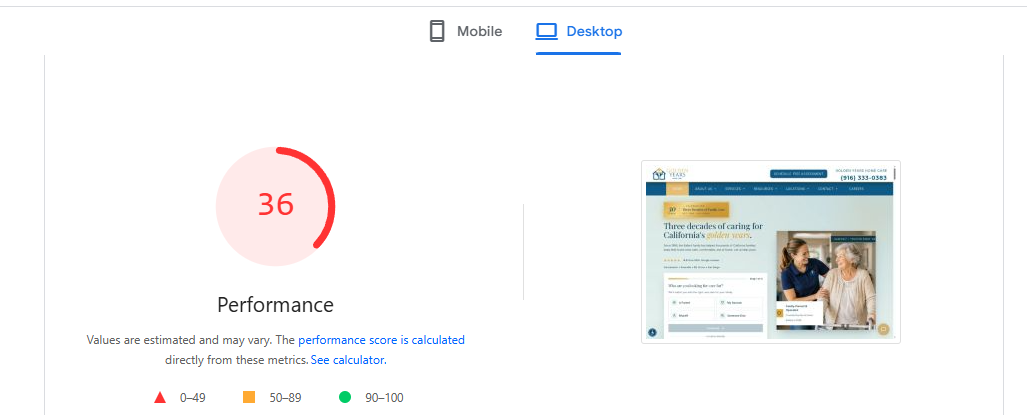
Old site: LCP 4.7s, Total Blocking Time 910ms
After: Desktop, 99/100
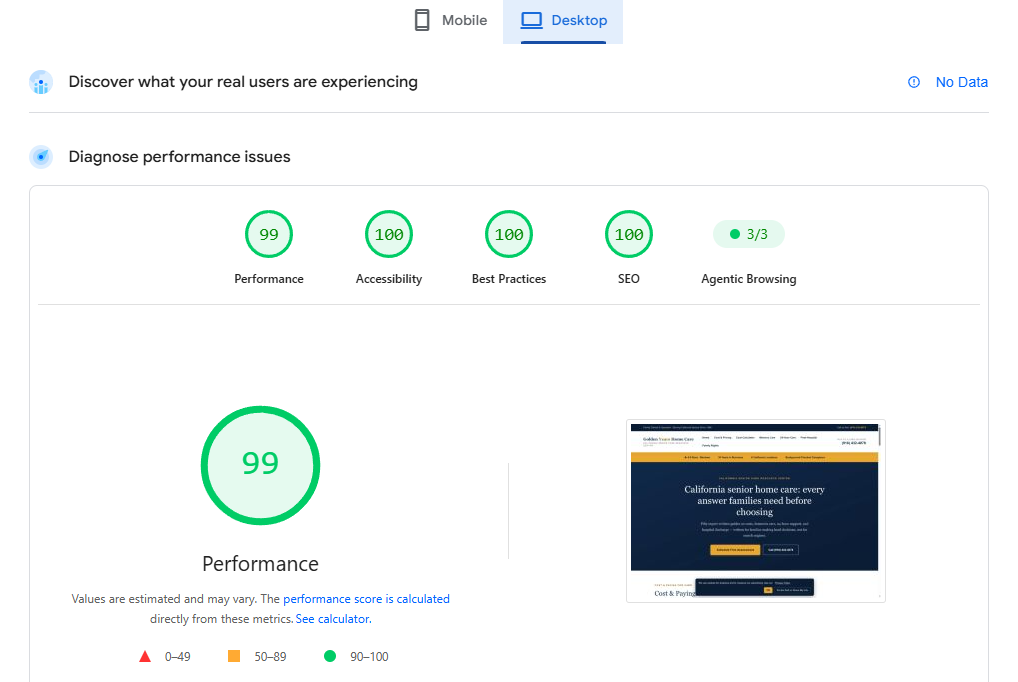
99 Performance · 100 Accessibility · 100 Best Practices · 100 SEO · 3/3 Agentic Browsing
Before: Mobile, 32/100
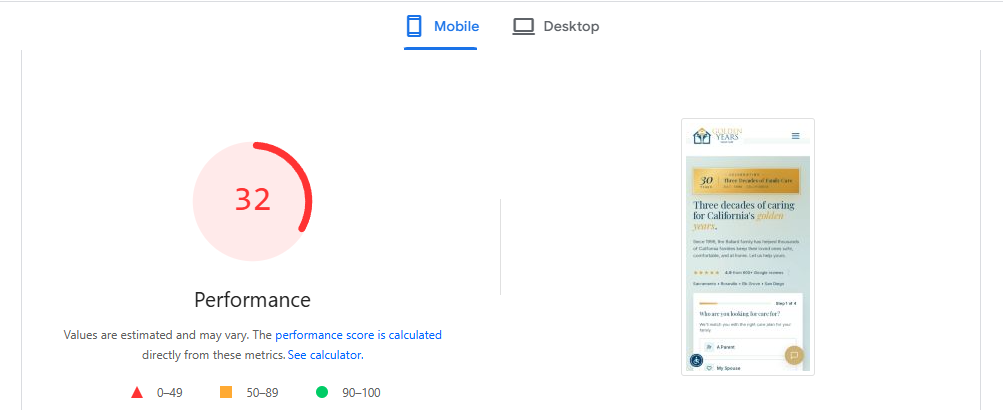
Old site: LCP 8.1s, Speed Index 20.8s on slow 4G
After: Mobile, 95/100
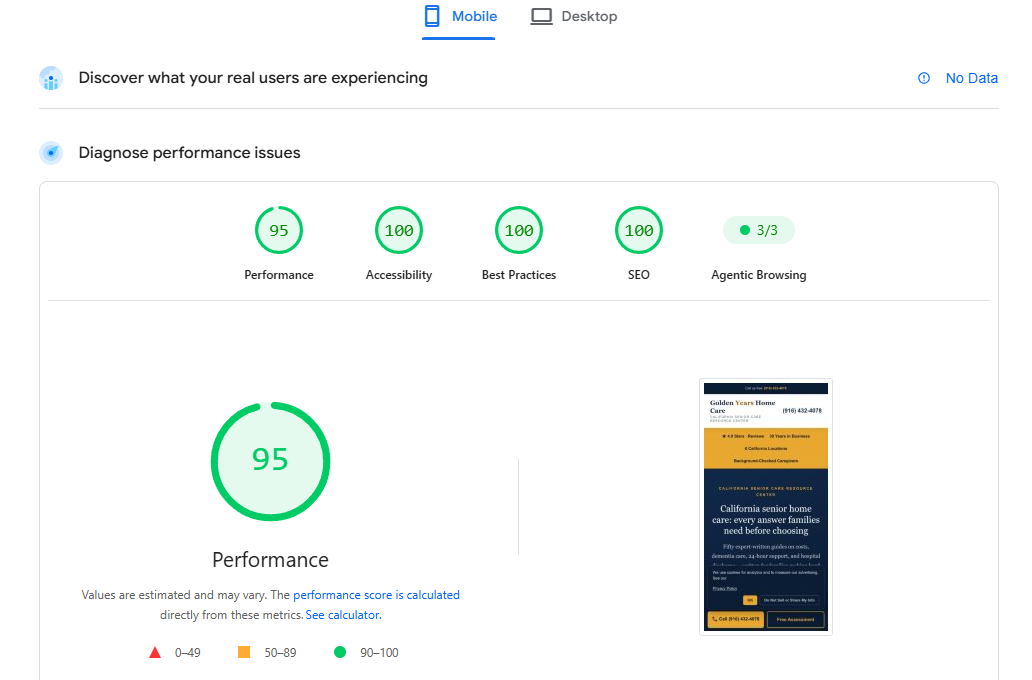
95 Performance · 100 Accessibility · 100 Best Practices · 100 SEO · 3/3 Agentic Browsing

Accessibility started at 85, not 100, and we said so plainly instead of only showing green scores. The flagged issues, contrast ratio, heading order, a missing main landmark, are now fixed and verified live, not just noted.
The error caught before it cost a client anything

Structured data validation isn't a formality. It's how real bugs get caught before paid traffic ever touches a broken page.

Google Search Console flag

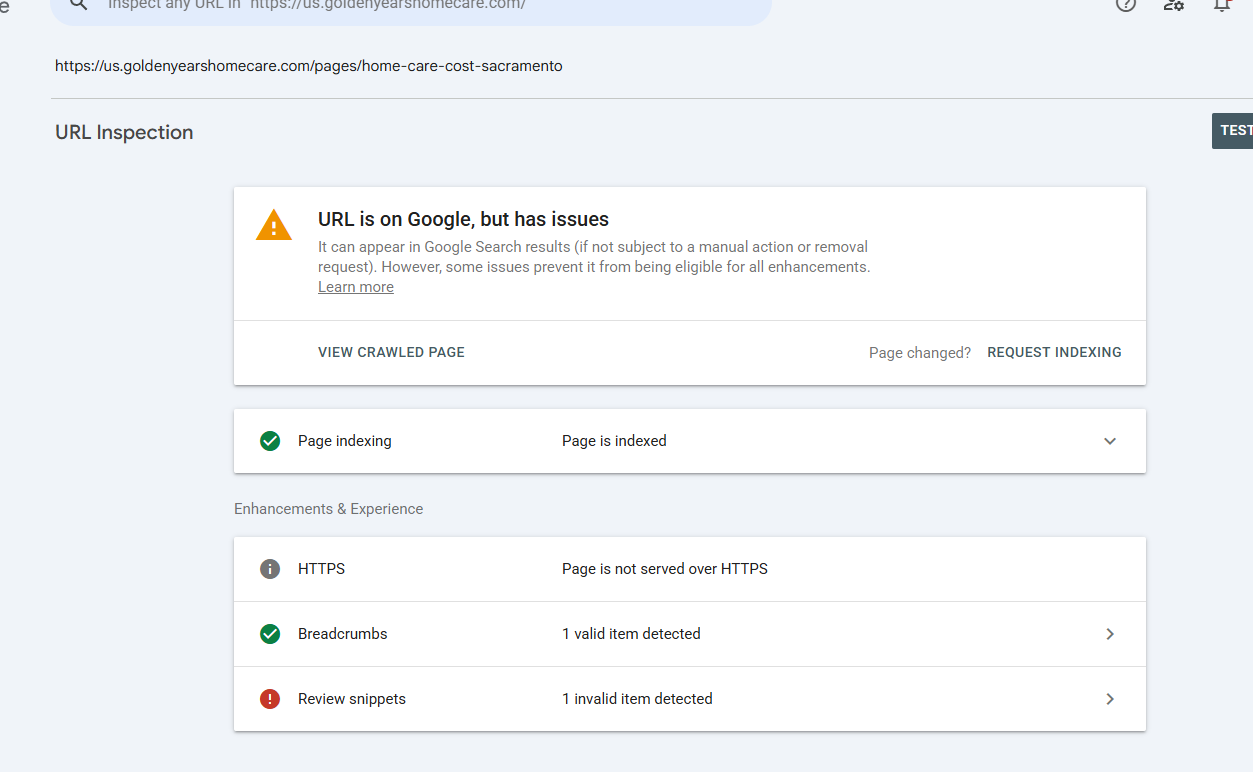
Review Snippets error: "Invalid object type for field '<parent_node>'"

The location pages carried a star-rating schema block under a business type Google doesn't recognize as eligible for review snippets (a subtle type-eligibility rule, not a syntax bug). Left unfixed, every location page would have shipped with a structured-data error live during paid campaign traffic.

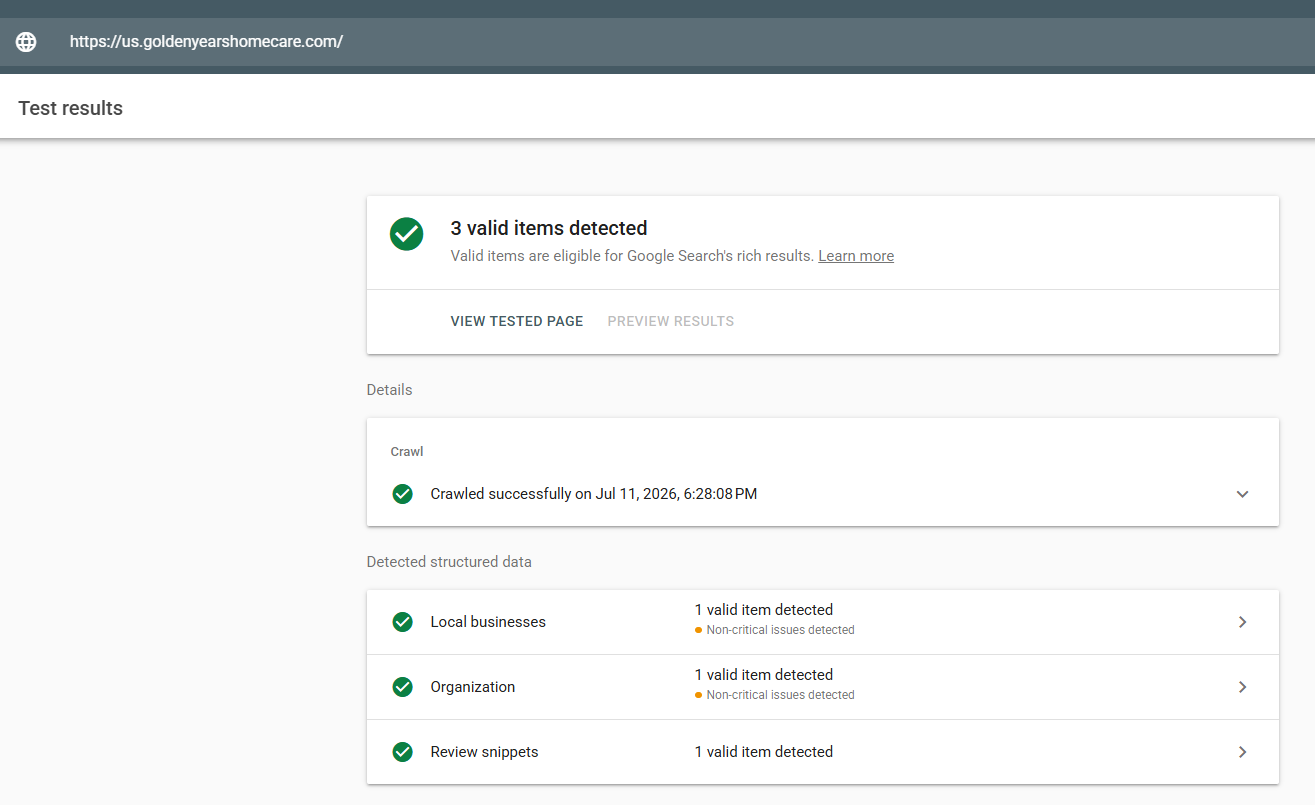
→ Diagnosed, corrected across all 5 location templates, re-verified clean via Rich Results Test before the second city campaign went live.

Before: flagged
Sacramento location page: invalid structured data
After: clean
Same schema class, re-verified: 3 valid items, zero errors

Early SEO rankings: Day 7

Worth being precise about what this is: AI Max isn't propping these rankings up indefinitely. It's the accelerant that got them there fast. The live campaign is what pushed Google to crawl, index, and start testing these pages as real answers within days instead of the usual weeks-to-months wait. Once a page has been served enough to prove itself as a genuinely good answer, Google keeps citing it independent of ad spend, the same way it would keep citing any page that earned its ranking organically. The pages still leaning on the campaign are the ones still building that track record. Traditional SEO earns that same trust through backlinks and time; this earns it through paid acceleration instead.

Still developing: not a final result

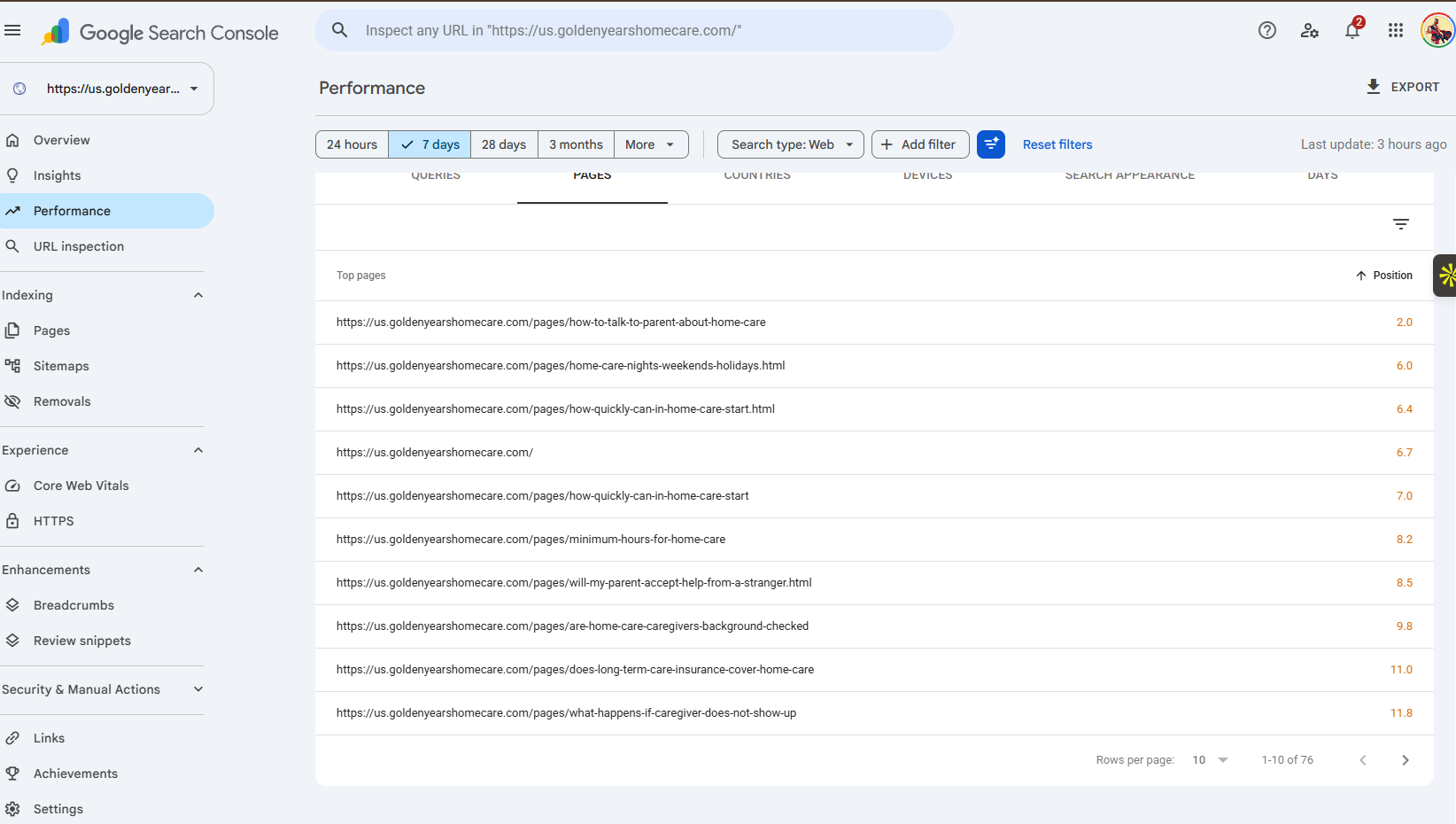
Seven days in, several pages are already ranking in Google's top 10 for their target questions, including position 2.0 for "how to talk to parent about home care." That's real, but it's early: these are blended average positions across a small number of queries, and new pages often see initial ranking volatility that settles (up or down) over the following weeks as Google gathers more signal. This section will be updated as the data matures. Treat it as a live in-progress result, not a settled claim.

Search Console: Performance by page, 7 days post-launch

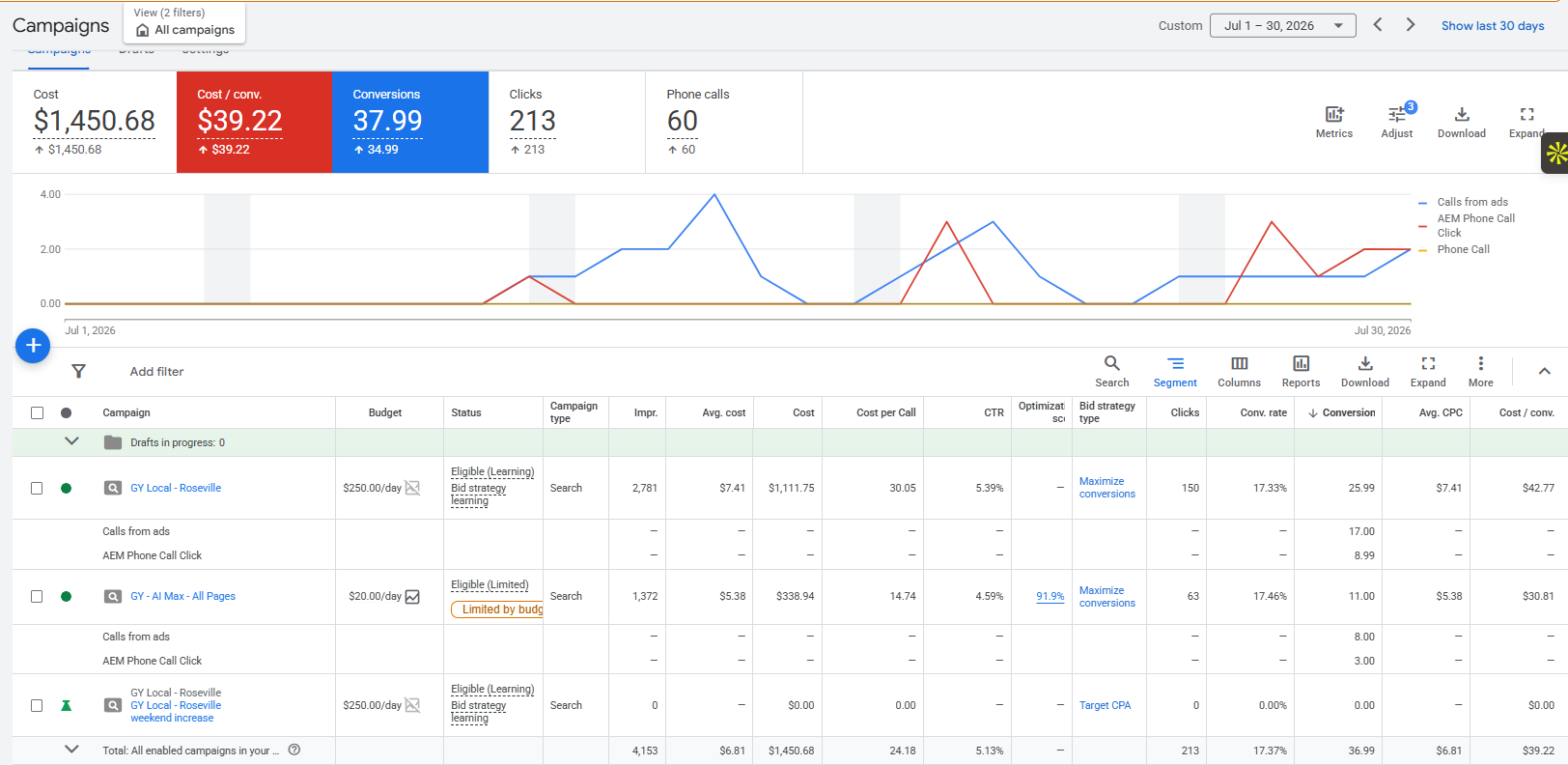
Ad performance: 21 days live

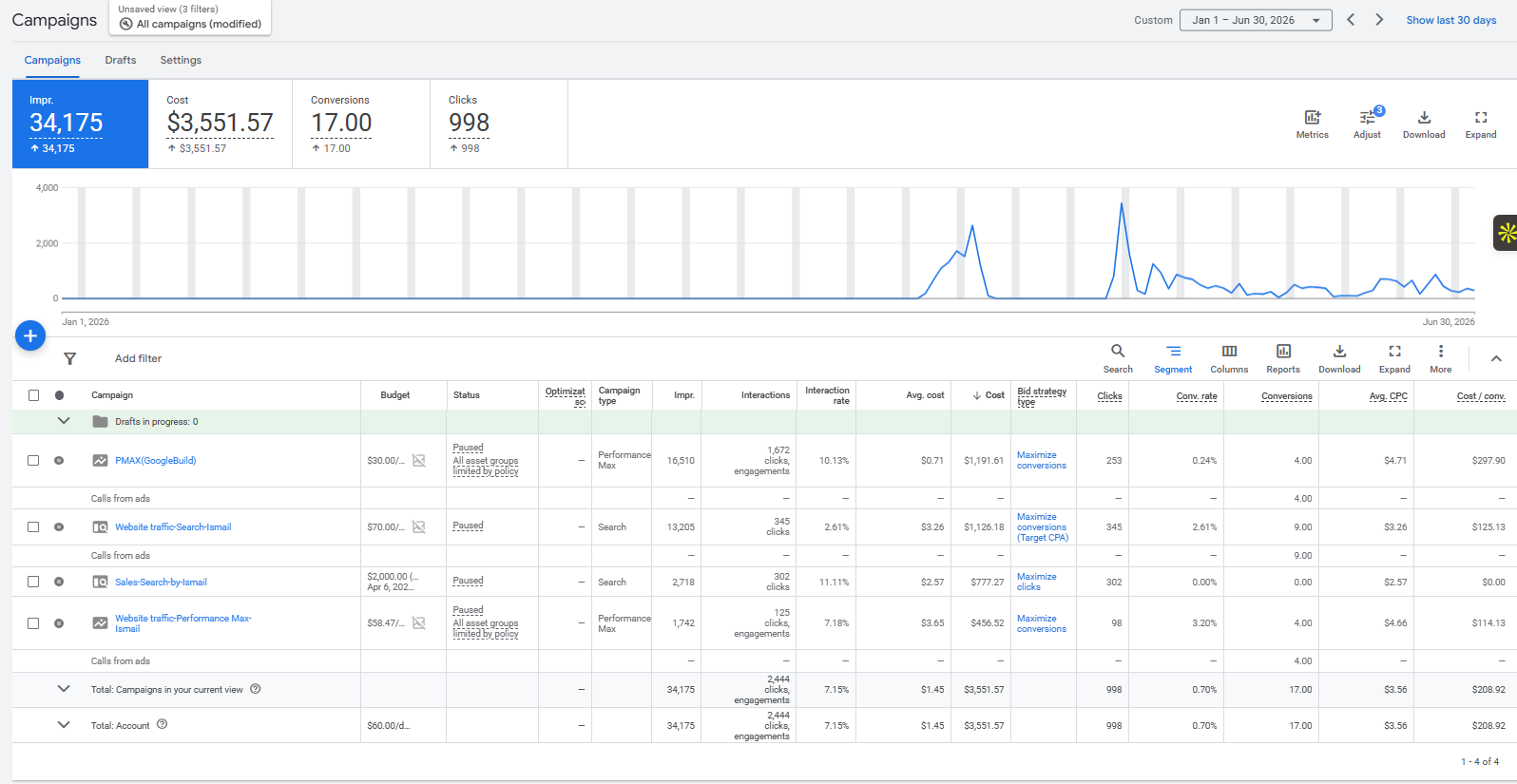
This is the paid-traffic layer of the AEM strategy: Google's AI Max and Local campaigns, sending traffic directly to the answer pages built above. Same account, same market, real baseline: the 6 months of PMax and Search campaigns that ran before this build (Jan–Jun 2026) versus AI Max + Local, which launched July 8 and has now been live for 21 days.

PMax + Search (6 months) AI Max + Local (21 days live)
Spend $3,551.57 $1,450.68
Conversions 17.00 37.99
Cost / conversion $208.92 $39.22

More than double the total conversions of the prior 6-month baseline (37.99 vs 17.00), already achieved in 21 days, at roughly 5.3x lower cost per conversion ($39.22 vs $208.92).

Maturing dataset — still monitoring

These campaigns launched July 8 and have now been live for three weeks, well past the initial learning-mode volatility of the first few days. Performance has held up as spend and volume scaled, not just in a small early sample.

37.99 conversions is a meaningfully larger sample than the original 9-day snapshot, and it already exceeds the full 6-month baseline in total conversions. This section will keep updating as more data comes in, but this is no longer an early or thin result.

Before: PMax + Search, 6 months
Google Ads: Campaigns, Jan 1 – Jun 30, 2026
After: AI Max + Local, 21 days live
Google Ads: Campaigns, July 1–30, 2026 (campaigns active since July 8)

Wondering why your own site isn't showing up in AI search?

Same process, same checklist, run against your actual domain: sitemap, schema, crawlability, and AI Overview eligibility, with a fix list you can act on immediately.

Pat Aglubat

Pat Aglubat
Happy to walk you through exactly how this would work for your business, no pitch, just a real look at your site.